
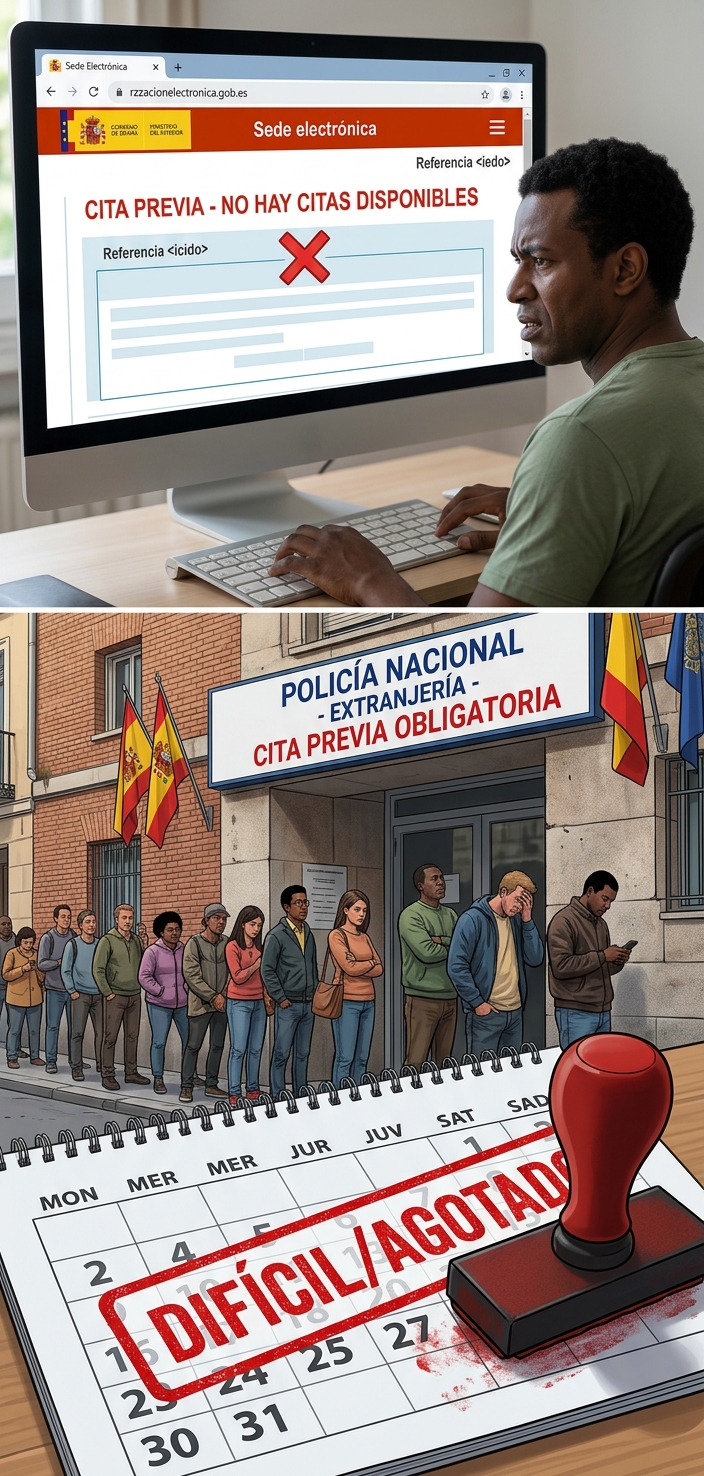
Anyone wishing to apply for a residence permit in Spain or to register as an EU citizen often encounters a common problem: the required appointment with the police (Cita Previa) is not available online. In some cases, appointments only become available for a short time and are snapped up within a matter of seconds.
The situation appears particularly problematic for people whose application deadline is about to expire. According to the law, depending on the type of residence permit, there is only a limited period of time after entry to complete the relevant administrative steps. For example, the TIE must generally be applied for within one month, and the EU registration certificate within three months of entry. Please note that, in reality, these deadlines are not usually enforced. It is common knowledge that it is practically impossible to find accommodation, register with the local authority (empadronamiento) and secure an appointment within such a short timeframe.
But why is it so difficult to get an appointment? What role do bots and so-called ‘appointment trading’ play? And what can those affected do if, despite repeated attempts, no appointment is available?
Why are there not enough appointments?
The shortage of available appointments stems from a combination of various factors. The biggest problem is likely, first and foremost, that demand from immigrants exceeds the authorities’ capacity. This is due to the fact that Spain has been regarded as a popular destination for immigration for years, but also because many people are leaving their home countries to seek refuge in Europe due to humanitarian or economic crises.
Furthermore, on 15 April 2026, Spain adopted a decree introducing an extraordinary regularisation programme designed to enable hundreds of thousands of people without residence permits to remain in Spain legally. Contrary to the original estimates of around 500,000 applications, over one million applications had been submitted by the deadline at the end of June 2026, placing an additional burden on administrative staff.
There is also another problem: appointments can be booked very quickly via automated systems.
The Spanish police have established in several investigations that so-called ‘bots’ have been used to automatically identify and book available appointments. These appointments are then sold via platforms to the highest bidder, where applicable.
Is such ‘appointment trading’ a criminal offence?
An appointment with the Spanish public administration is, in principle, a free administrative service. The issue becomes particularly problematic when individuals or groups use technical means to block a large proportion of the available appointments, thereby hindering normal access to the state system.
The Spanish police have already carried out several investigations into this matter.
In May 2023, for example, a network was uncovered that used a bot to automatically book appointments and then resell them for between around 30 and 200 euros. According to the police, 69 people were arrested and a further 25 were under investigation. The system used bypassed all the security barriers on the government’s booking website. It was so aggressive that it completely intercepted and blocked 500 available appointments in less than 12 seconds.
In 2024, too, the police took action against a group accused of using bots to block appointments and subsequently offering them for sale. Forged documents also played a role in this case.
Depending on the individual case, offences such as computer sabotage and data corruption, fraud (estafa), forgery of documents (falsedad documental) or the formation of a criminal organisation (organización criminal) may therefore be considered.
However, it is important to make a legal distinction:
Not every instance of providing assistance in securing an appointment for a fee automatically constitutes a criminal offence.
Rather, the specific method used and the technical means employed can be decisive. For example, someone who automatically intercepts government appointments, blocks appointments on a massive scale or manipulates the administrative system finds themselves in a completely different situation to a person who, for instance, offers legitimate advisory or translation services to assist in securing appointments.
Applicants should therefore bear in mind:
Caution is advised regarding offers where an appointment is ‘guaranteed’ in return for a high fee. Aside from potential legal issues, there is a risk that this could simply be a scam and that you might still end up without an appointment. Furthermore, these operators require highly sensitive personal data (passport copies, full name, date of birth) in order to book an appointment, which leaves the door wide open to identity theft.
As appointments are usually personalised and linked to your passport or NIE number, you will be turned away at the counter if the details do not match exactly upon entry.
What is the Spanish administration doing to tackle the problem?
The Spanish authorities are aware of the issue.
In a parliamentary response from 2026, the government confirmed that the mass hoarding of appointments for foreign affairs is a nationwide problem.
According to the government, technical measures are being examined or implemented, amongst other things, to prevent the automated booking of large numbers of appointments.
The problem is therefore not unknown. At the same time, the continuing complaints show that booking appointments remains a challenge in many places.
New measures are now being trialled in some offices and provinces. For example, the Balearic Islands are introducing an automated appointment booking system for the TIE (residence card) once a residence permit has been granted via their immigration office. Time will tell whether these processes become established.
What can you do if you cannot get an appointment?
If you cannot get an appointment, you should first of all not panic and, in particular, avoid taking up dubious offers via social media or messaging services.
1. Use only official systems
Appointments should be sought via the official systems of the Spanish administration or the relevant authority.
For EU citizens, this applies, for example, to the appointment type ‘Policía-Certificados UE’. For the TIE, depending on the procedure, ‘Policía-Toma de huellas (Expedición de tarjeta)’ is relevant, amongst others.
The type of appointment required depends on the specific procedure.
2. Check regularly for new appointments
You usually have the best chance of securing an appointment on weekdays (particularly Mondays and Wednesdays) in the mornings between 07:00 and 09:00, as well as occasionally in the late afternoon.
The fact that no appointment is available today does not automatically mean that no appointments will be offered in the long term.
Availability may change if new appointments are made available or existing ones are cancelled.
It may therefore be worth checking the official system regularly.
3. Check other relevant authorities
Responsibility and appointment availability may vary depending on the province and the specific procedure.
For example, if you cannot get an appointment in a major city, you should check whether another relevant authority or police station might be responsible for the procedure in question.
However, you should not simply choose any police station at random. The decisive factor is which authority is responsible for your place of residence and the specific procedure in question. The appointment must always be booked within the province where you are registered.
4. Document unsuccessful appointment attempts
Anyone under time pressure due to a statutory deadline should document their attempts to book an appointment.
The following, for example, may be helpful:
Screenshots of the appointment portal
Date and time of attempts to book an appointment
Emails to the relevant authority + replies from the authority
Evidence of telephone or in-person contact
This documentation does not replace an application and does not automatically constitute an extension of a deadline.
However, it may be helpful later on to prove that you made a timely effort to book an appointment.
5. Seek professional help
It is always advisable to seek the support of a solicitor specialising in Spanish immigration law if you are unable to succeed on your own or have questions about your case.
Please feel free to contact us: www.artemislaw-europe.com
ARTICLE BY ANNA-LENA MALCHER, TRAINEE SOLICITOR